The Healing Powers of Sound
If you’ve been dipping your toes into the wellness world, chances are you’ve come across sound healing or seen offerings like kirtan. You might be wondering what the difference is between the two, what each offers in terms of healing, and which one might be the best place to start. I’m here to shed some light on both—and hopefully inspire you to try something new.
To get a fresh and unbiased perspective, I decided to bring in two very special guests: my parents. My papa is 80 and my mama 70—definitely not your average sound healing crowd, which made them perfect for the experiment.
For being a relatively small town, Bozeman has an amazing amount of sound-based healing offerings. I reached out to two local guides in this realm: Allison Leadbetter, founder of The Light House on Main Street, who specializes in a variety of sound healing modalities, and Victor Haug, who leads Chai and Chanting, a free kirtan gathering every other Sunday at the Wild Wisdom Collective.
Both Allison and Victor are Montana natives who, through their own spiritual journeys, discovered how music could help them surrender, connect, and heal. Having both received musical training as children, they found a natural affinity with sound-based practices, turning them into tools for deeper self-exploration and community connection.
First Stop: Gong Bath at The Light House
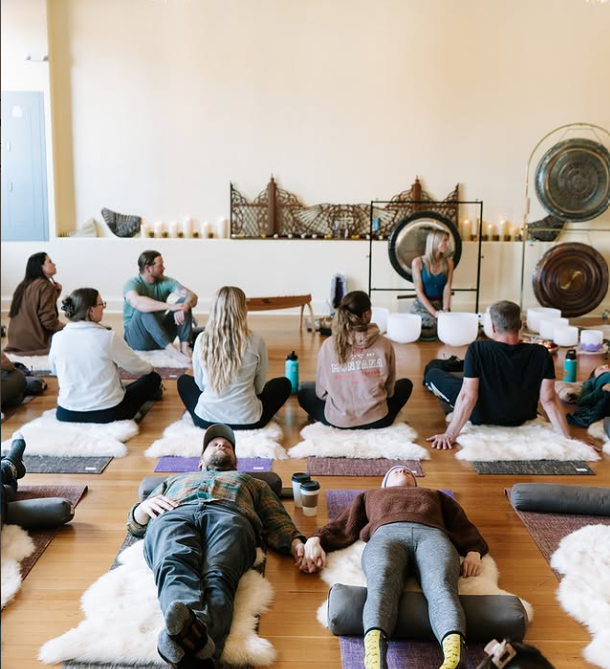
Sound Healing at the Light House in Bozeman MT
Our first session was a gong bath with Ally at The Light House. We were greeted with a floral elixir “to open the heart,” and invited into a softly lit room layered with fluffy white sheepskins. Once settled, we lay down, closed our eyes, and let the waves of sound wash over us.
As Ally explained, “A sound bath is an immersion into resonance—a sonic landscape that invites deep rest, release, and remembrance. It’s for anyone who feels overstimulated, disconnected, or curious about their inner world.”
At one point, I heard both my parents snoring quietly and, for a second, felt embarrassed. But Ally reassured us at the end: “Sleeping during sound healing is wonderful. It means your body feels safe enough to let go. It allows you to soften your defenses and listen with more than just your ears—with your whole being.”
One of the gongs, to me, sounded like a sea dragon. When I told her that, Ally said something that stayed with me:
“Certain frequencies bypass the analytical mind and go straight to the heart, the nervous system, the subconscious. That’s why a single tone or harmony can move someone to tears. It’s not just heard, it’s felt. This is resonance. This is coherence—harmonious order.”
We drove home in silence, deeply relaxed. That night, we all slept like babies.
Second Stop: Chai and Chanting
A couple of weeks later, we joined Victor’s kirtan session at 9 a.m., arriving to the smell of fresh homemade chai and a warm circle of people. Some were newcomers like us, others were clear regulars. Victor handed us lyric sheets and cups of chai, and explained:
“Kirtan is a call-and-response form of devotional singing. You don’t have to be Hindu or believe in a specific god for these chants to work their magic. They work through sound, breath, and presence.”
We sang for about an hour. Some chants were slow and meditative, drawing us inward. Others were rhythmic and upbeat—almost danceable. Kirtan, I realized, takes you on a journey. You’re not just listening; you’re actively participating.
The most touching moment came when I saw my dad wipe away tears during a chant dedicated to the Divine Mother, written by Paramahansa Yogananda. It cracked my heart open a little too.
After the session, Victor shared that group chanting helps regulate breath and heartbeat, reduces anxiety, and boosts mood by releasing oxytocin and endorphins.
So... What’s the Difference?
While both practices are forms of sound healing, they offer different gateways into the experience:
Sound baths are deeply receptive. You simply lie down, relax, and allow the sounds to move through you. They invite surrender, stillness, and rest.
Kirtan is more active. You participate with your voice, opening your heart through devotion and vibration. It’s about shared energy, expression, and communion.
Yet at their core, both practices invite us to move beyond the ego, to return to the resonant field of the heart—a space of peace, coherence, and connection.
My mom fell in love with the gong bath. My dad now asks when the next kirtan is. As for me, I’ll be keeping both in my life.
I hope this inspires you to explore the healing powers of sound. Maybe I’ll see you at one of these sessions—chai in hand or lying next to you under the gongs.
With love and light,